Saving money sounds simple: spend less than you earn and keep the difference. In practice, the difference has a way of disappearing. A dinner out here, a surprise bill there, and the “extra” you planned to save at the end of the month is gone before the month ends. You are not alone. In Bankrate’s 2026 Emergency Savings Report, 24% of Americans said they have no emergency savings at all, and only 47% said they could cover a $1,000 unexpected expense from savings.
A money saving challenge flips the usual approach. Instead of hoping there will be something left over, you commit to small, specific deposits on a schedule, and you track every one of them on paper. It turns saving into a game with rules, a finish line and a visible score. In this guide you will learn why these challenges work, which one fits your budget, how to set one up so it survives real life, and what to do with the money once you reach the end. You can download the full printable savings challenge planner for free further down.
A quick note: this article is general education about saving money, not personalized financial advice. If you are dealing with debt collectors, high-interest loans or a tax problem, talk to a qualified professional first.
Why savings challenges work when willpower does not
Most people do not fail to save because they lack discipline. They fail because saving is invisible and delayed: the reward is months away, while the temptation to spend is right now. A good savings challenge fixes that with four simple mechanisms that behavioral scientists have studied for years.
- Visible progress. Every deposit becomes a box you color in. James Clear, in Atomic Habits, explains that making progress visible is one of the most reliable ways to keep a habit going: a tracker turns an abstract goal into a streak you do not want to break.
- A commitment made in advance. When you decide the amount and the schedule before the month starts, you remove the daily “should I save today?” negotiation. Economists Nava Ashraf, Dean Karlan and Wesley Yin tested this idea with a commitment savings account in the Philippines. In their 2006 study, average savings balances of people offered the account were 82% higher after one year than those of a comparison group.
- Small starts that grow. Many challenges start with $1 or $2 and increase slowly. Richard Thaler and Shlomo Benartzi used the same logic in their Save More Tomorrow program, where employees committed to raising their savings rate with each future pay raise. In their 2004 study, participants’ average saving rate climbed from 3.5% to 13.6% over 40 months.
- A clear start and finish line. Researchers Hengchen Dai, Katherine Milkman and Jason Riis described the fresh start effect in 2014: people are more likely to start goals after “temporal landmarks” such as a new week, a new month, a birthday or January 1st. A challenge with a start date and a finish date gives you both a fresh start and a reason to finish.
In short, a challenge is not a trick. It is a small system: a goal, a schedule, a tracker and a deadline. That system does the heavy lifting that willpower cannot do on its own.
Before you start: four decisions that make or break a challenge
Five minutes of planning now will save you from quitting in week three. Answer these four questions before you print anything.
1. What is the money for?
“Saving more” is vague. “A $1,000 emergency cushion by June” or “$1,800 for a summer trip” is a goal your brain can picture. Pick one goal per challenge and write it at the top of the page. A named goal makes it much harder to raid the money for something else.
2. Can your budget really afford it?
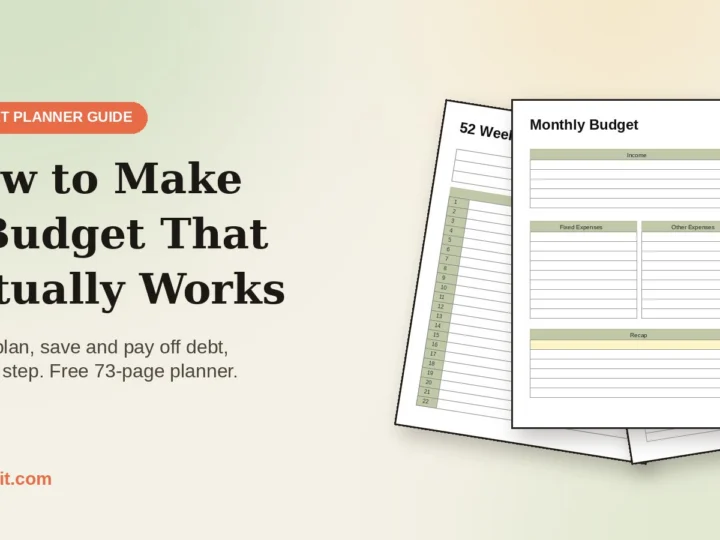
A challenge should stretch you a little, not break your budget. Look at your last month of spending and find the amount you could move to savings without missing rent or bills. If you do not know yet, start with our step-by-step guide on how to make a budget that actually works: it shows you where your money goes before you decide how much to save.
3. Where will the money live?
Many viral challenges suggest stuffing cash into envelopes. It feels great, but cash at home earns nothing and is easy to spend. When TIME reviewed the 100 envelope challenge in 2023, financial education instructor Patrick Di Cesare compared stored cash to “burying it in your yard”, and recommended a high-yield savings account instead. A good compromise: color in the box on paper, then move the money to a separate savings account the same day. You keep the fun of the tracker and your money earns interest.
4. When will you start, and how often will you deposit?
Pick a start date that feels like a fresh start (a Monday, the first of the month, or the day after payday) and decide your rhythm: daily, weekly or every payday. Then write both on the challenge page before you begin.
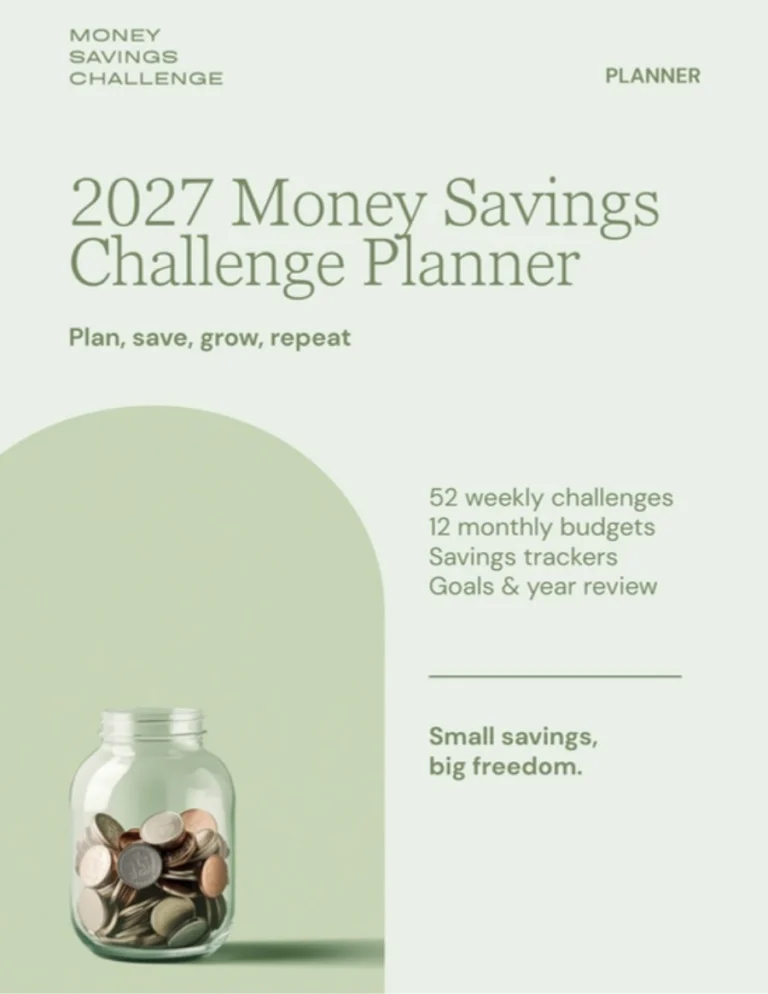
- 79 pages, US Letter PDF
- 30+ savings challenges to print
- Instant download, no spam
Get the free savings challenge planner
All 79 pages: 30-day, 26-week and 52-week challenges, the 100 envelope challenge, an emergency fund tracker, goal funds and a no-spend month review.
Beginner challenges: start small and win fast
If you have never managed to save consistently, begin with a challenge you can finish in about a month. Early wins build the confidence you need for bigger goals.
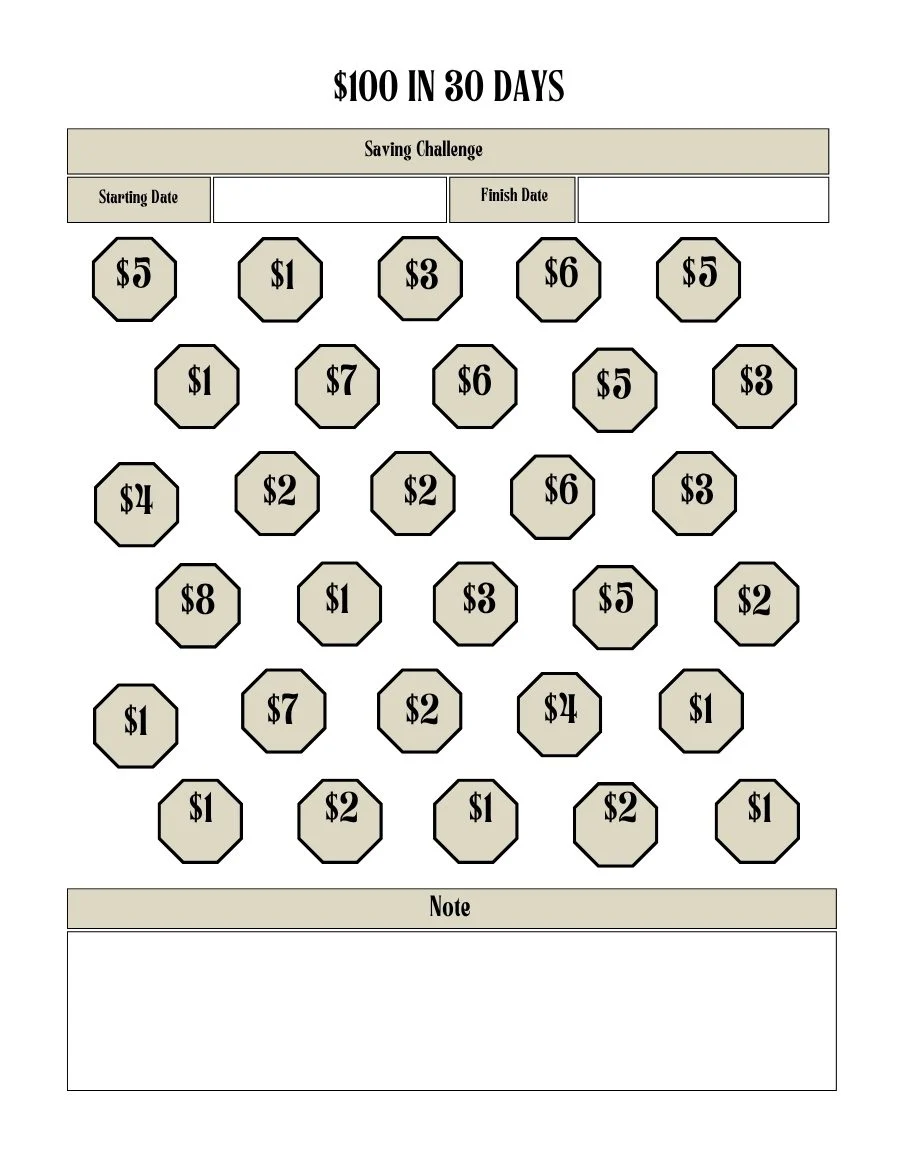
Save $100 in 30 days
This is the gentlest 30 day savings challenge. Each box holds a small amount between $1 and $8, and together they add up to $100. Some days you save the price of a coffee, some days less. Pick the box that fits the day, color it in, and move on. By the end of the month you have proof that you can save, and $100 to start your emergency fund.
Save $300 in 30 days
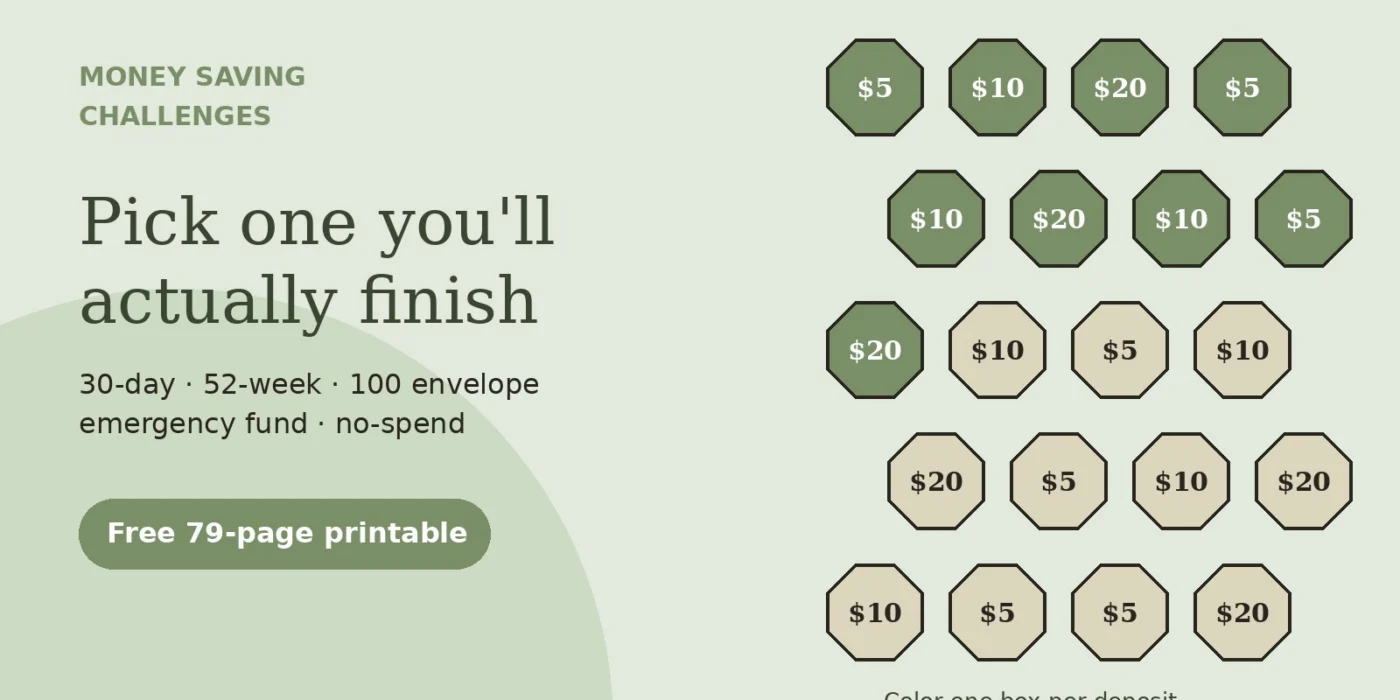
The next step up uses three amounts only: $5, $10 and $20. It works well if you get paid weekly or earn tips, because you can choose a $20 box on a good day and a $5 box on a tight one.
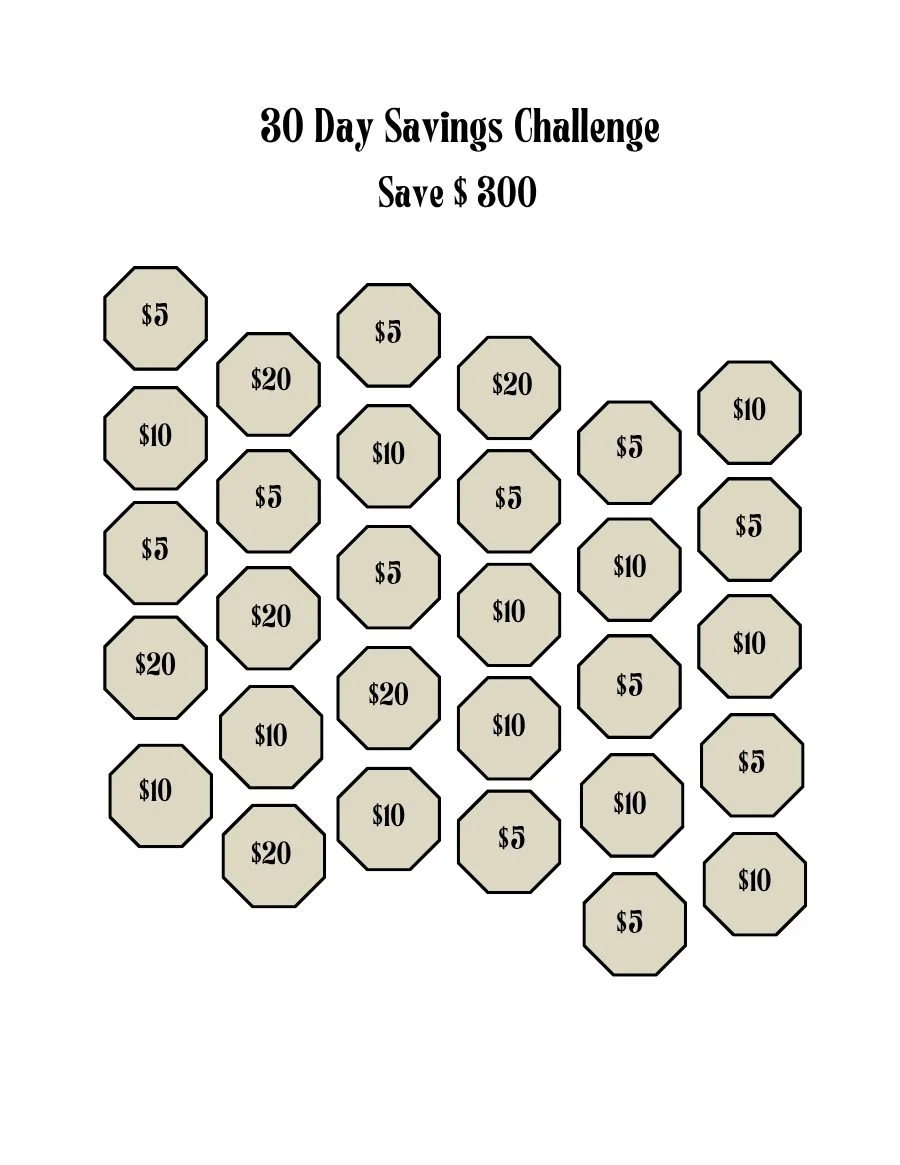
Tip: choose your boxes in any order. Doing the big ones early, when motivation is high, makes the end of the month feel easy.
Short sprints: bigger results in a few weeks
Once a 30-day challenge feels comfortable, try a sprint with a more ambitious target. These work well before a known expense, such as holiday shopping or a car registration.
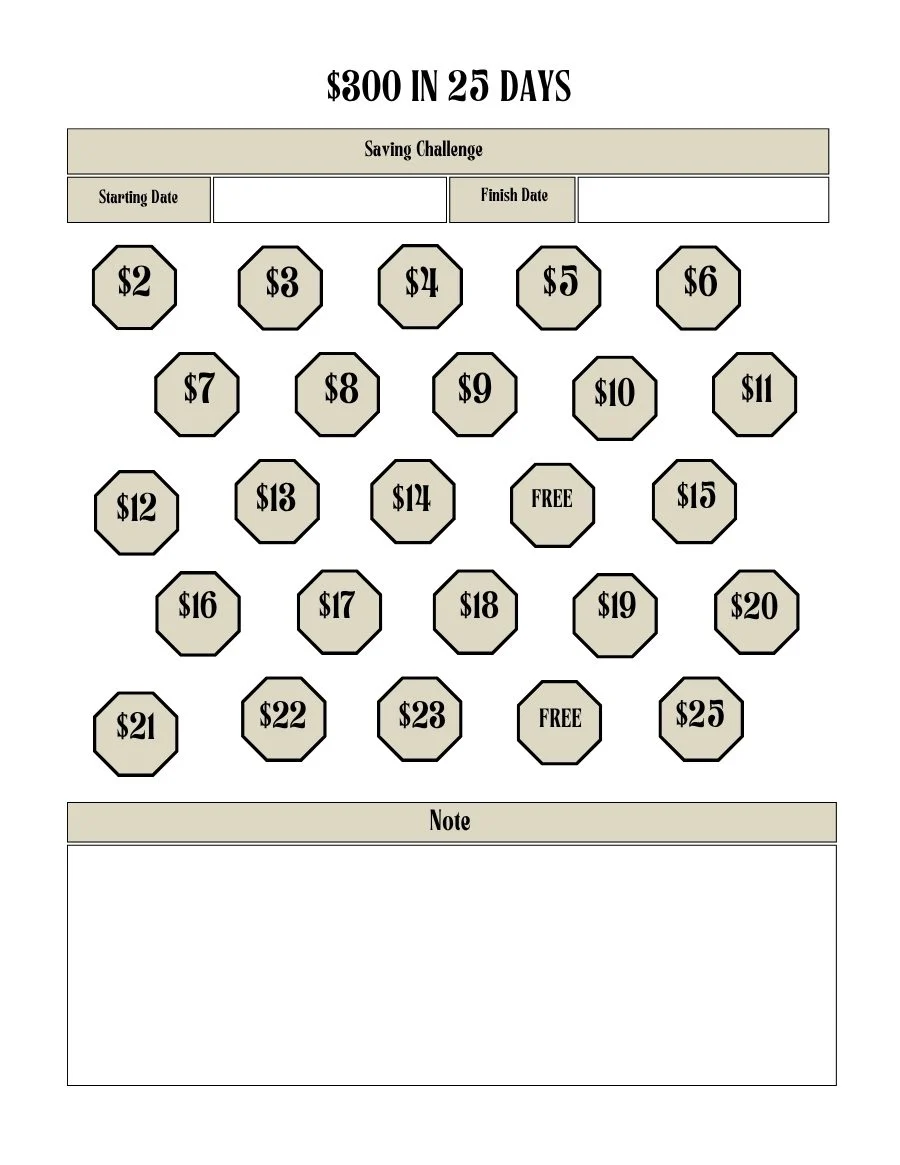
Save $300 in 25 days (with two free days)
Each box is a different amount from $2 to $25, and two boxes say FREE. Those free days are more important than they look: they let you skip a day without breaking the challenge. Planned flexibility is what keeps people going when life gets in the way.
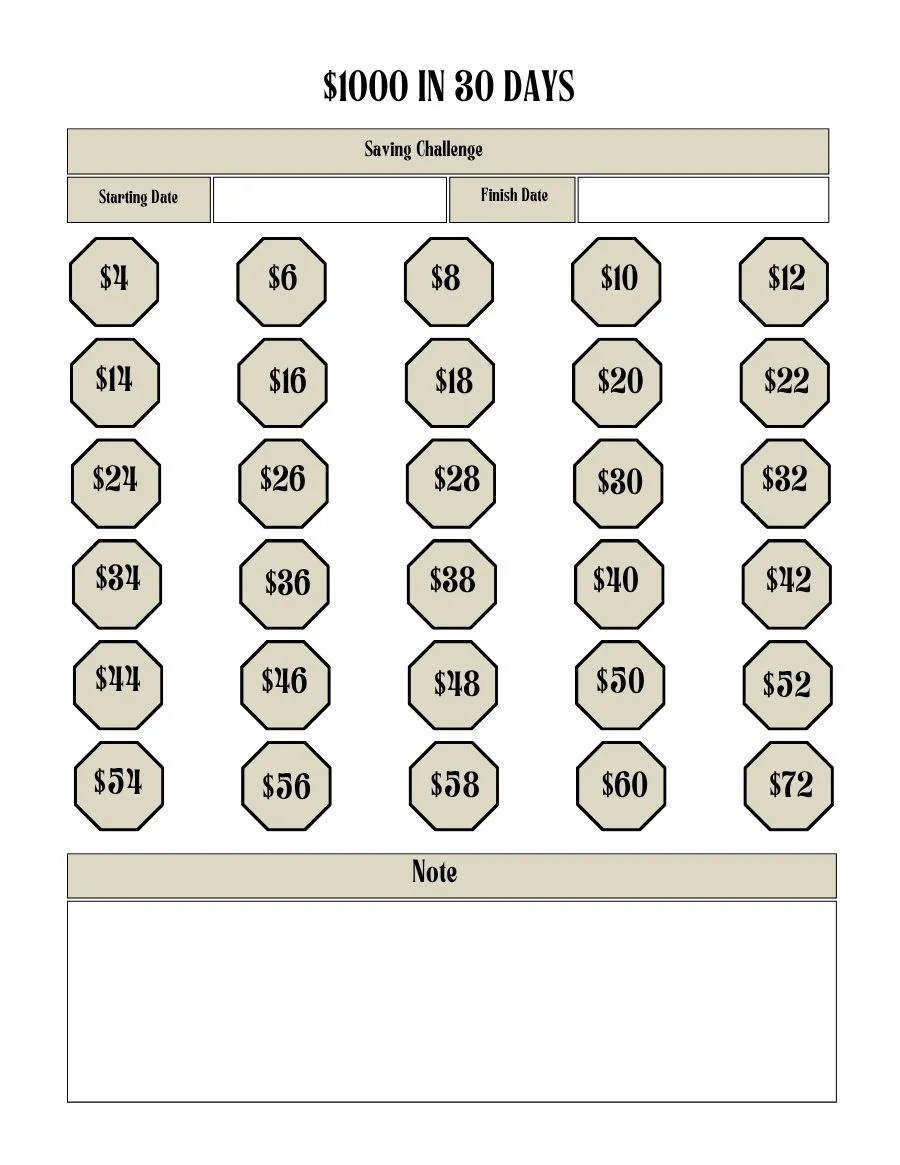
Save $1,000 in 30 days
This one is intense: the amounts rise from $4 to $72. It suits a month with extra income (a bonus, a tax refund, a side project) or a month where you have already cut spending with a no-spend challenge. Be honest before you start. If the numbers are far beyond your budget, a longer challenge will get you to $1,000 with far less stress.
Weekly challenges: the 26-week and 52-week classics
Weekly challenges are the best fit for most people, because one deposit a week is easy to remember and easy to link to payday.
The 26 week savings challenge
You save $2 in week 1, $4 in week 2, and add $2 every week until you save $52 in week 26. After six months you have saved $702. It is a great way to fund a specific goal, such as holiday gifts or a trip, within half a year.
The 52 week savings challenge
The most famous 52 week savings challenge works the same way with $1 steps: $1 in week 1, $2 in week 2, up to $52 in week 52. The total is $1,378. Two variations make it easier to keep:
- The reverse challenge: start with $52 in January and finish with $1 in December, when holiday spending peaks.
- Your own amounts: use a blank 52-week tracker, choose a weekly amount that fits your budget, and log the deposit and the running balance each week. Seeing the balance column grow is surprisingly motivating.
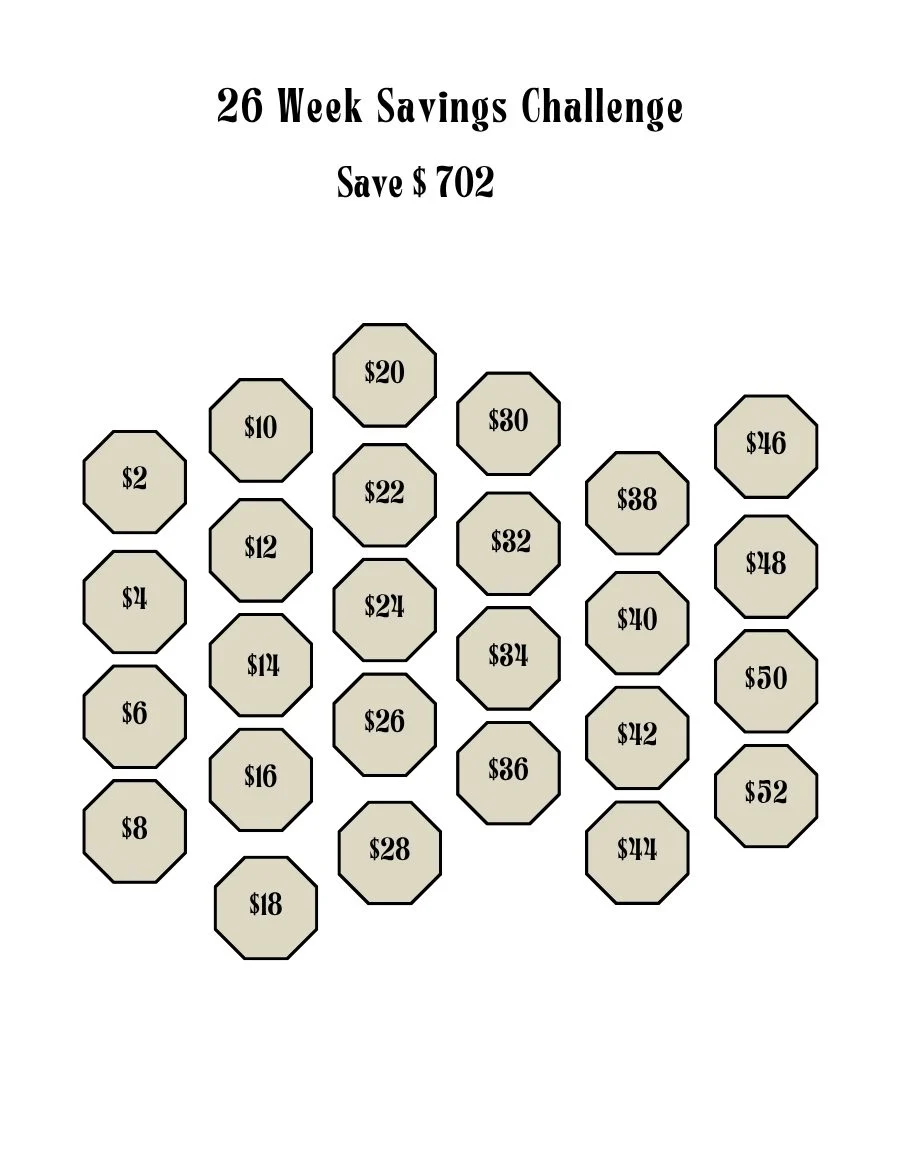
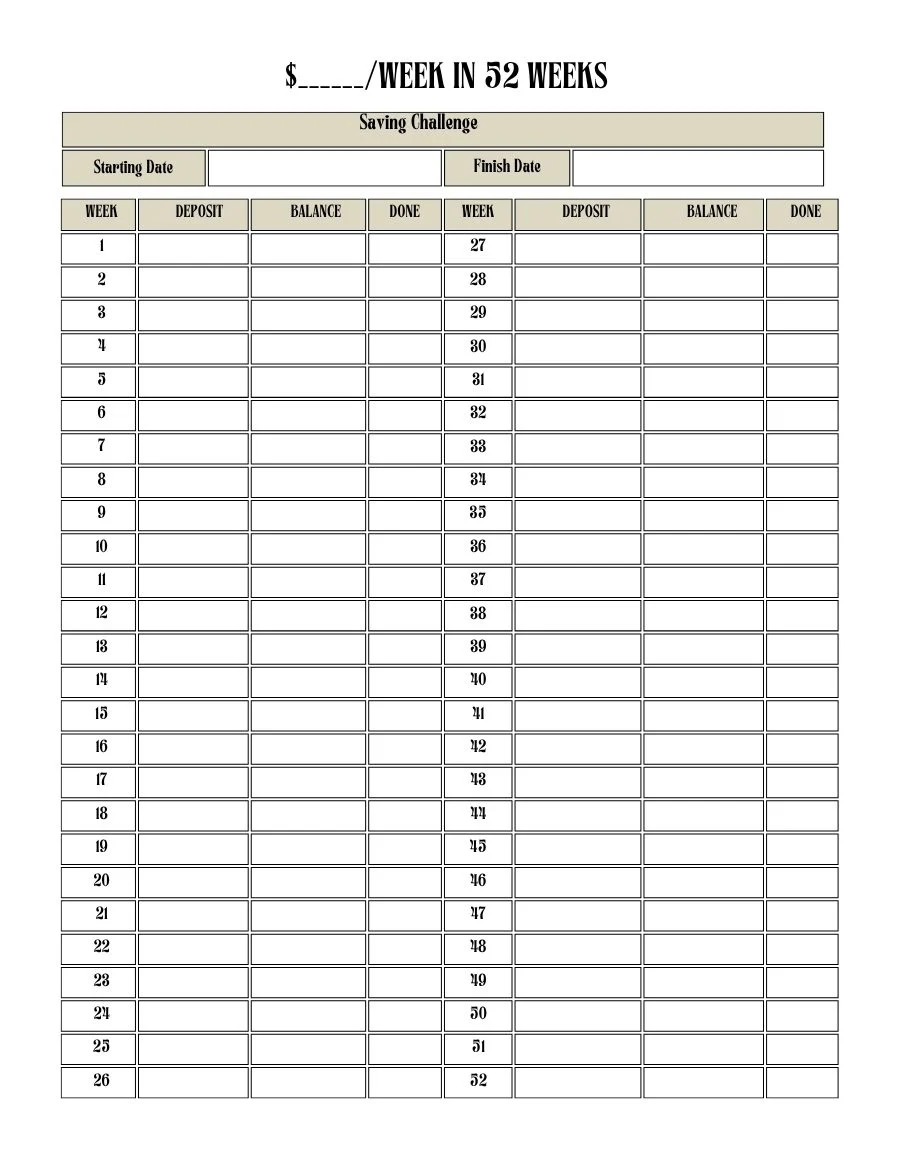
This is the Save More Tomorrow idea in action: the first weeks are so small that starting feels effortless, and by the time the amounts grow, saving has become a habit.
Prefer to track your savings on a tablet?The Money section of The Everything Planner 2027 includes a savings jar, sinking funds, bills and debt payoff pages, all one tap away from your calendar.
The 100 envelope challenge: fun, viral and demanding
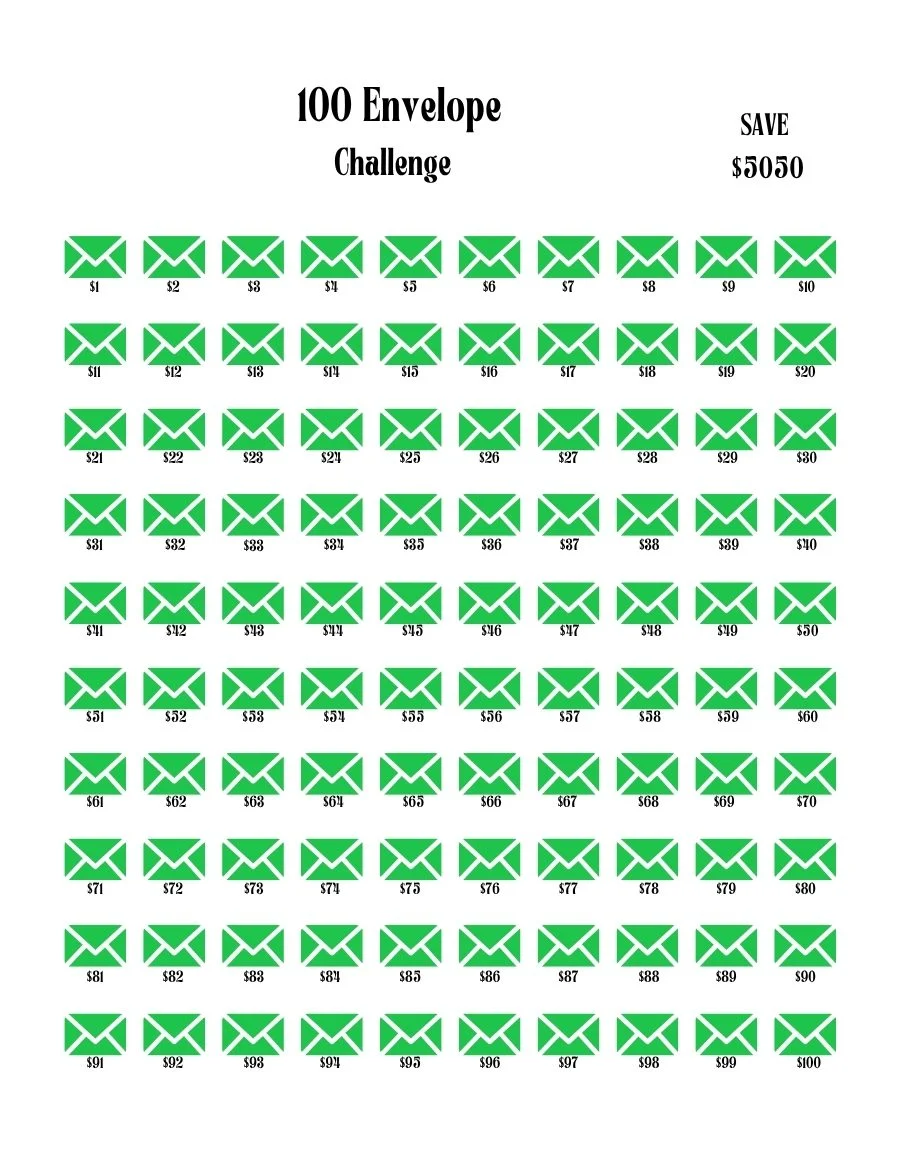
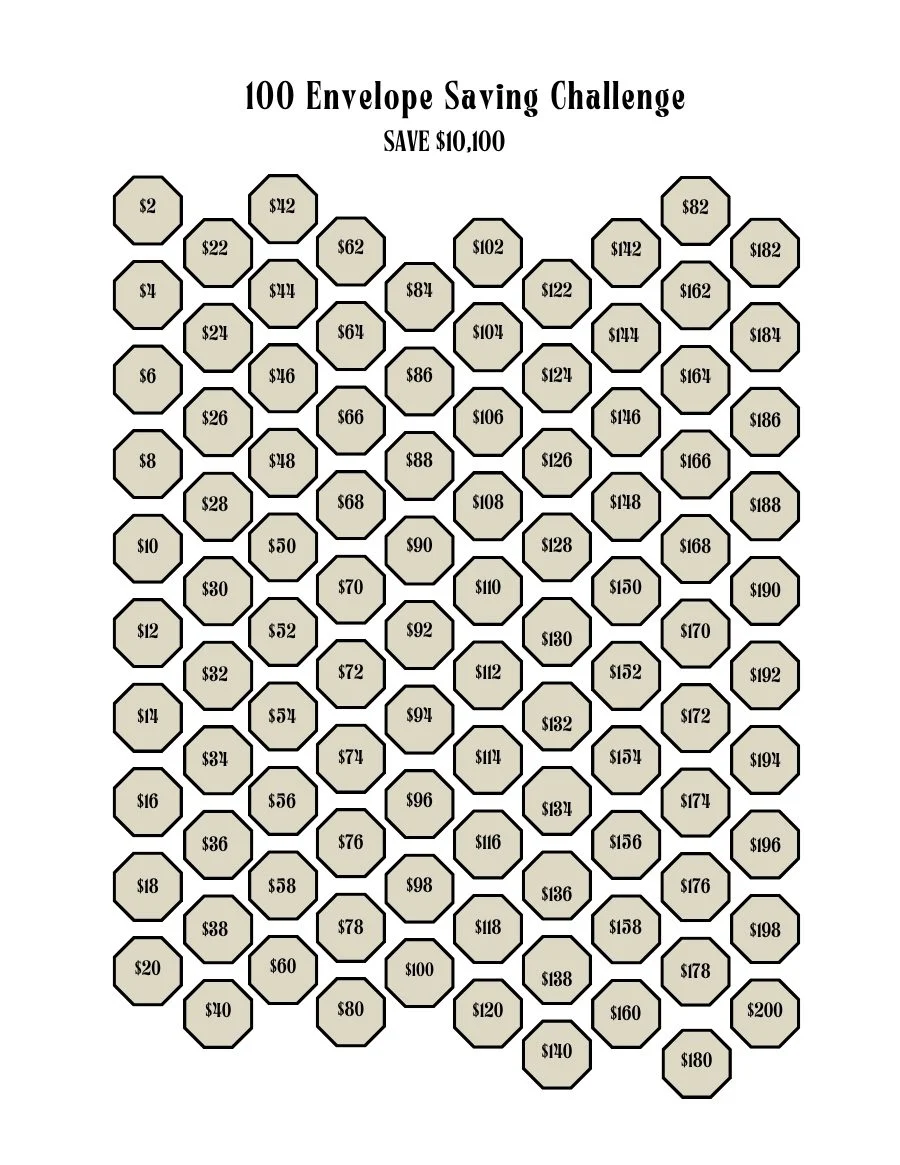
The 100 envelope challenge went viral on TikTok in 2023. The idea: number 100 envelopes from $1 to $100, pick one at random each day (or a few per week), and put that amount inside. When all envelopes are full, you have saved $5,050. A doubled version, with envelopes from $2 to $200, reaches $10,100.
It is fun because every draw is a small surprise, and the random order spreads big and small amounts across the weeks. Financial counselor Jen Hemphill told TIME that the challenge is “fun, visual” and brings accountability. The catch is the size of the envelopes: $5,050 in 100 days is about $50 a day on average, and if you fill them in order, the last days ask for $90 to $100 each. That is well beyond most monthly budgets.
Three ways to make it work:
- Stretch the timeline. Fill two envelopes a week and finish in about a year.
- Draw from the paper tracker, not real envelopes, and transfer the amount to your savings account.
- Allow a “swap” rule: if you draw a big number on a tight week, put it back and draw again.
The emergency fund challenge: your first $1,000
If you only do one challenge this year, make it this one. An emergency fund is what stops a flat tire or a dentist bill from turning into credit card debt. Dave Ramsey’s plan in The Total Money Makeover starts exactly here, with a starter emergency fund of $1,000, before anything else.
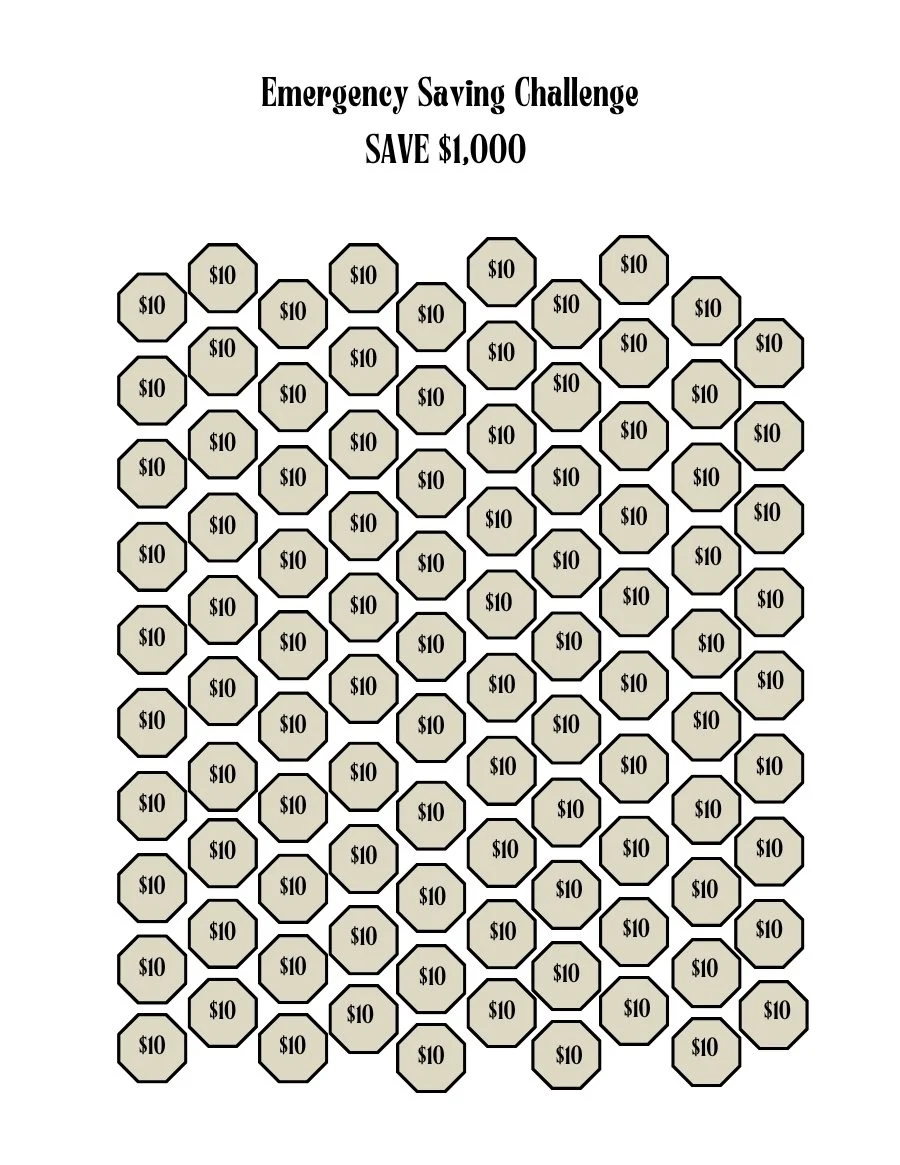
The emergency challenge breaks $1,000 into one hundred $10 boxes. Ten dollars is small enough to find almost every day: skip one takeout lunch, return an unused purchase, sell something you no longer need, or round up your grocery budget. Every box you color is one percent closer to real peace of mind.
Keep this money in an easy-access savings account, separate from your checking account, and only use it for real emergencies. Once you reach $1,000, keep going toward three to six months of essential expenses. According to the same Bankrate report, only 46% of Americans have enough emergency savings to cover three months of expenses.
Goal funds: save for the things you are excited about
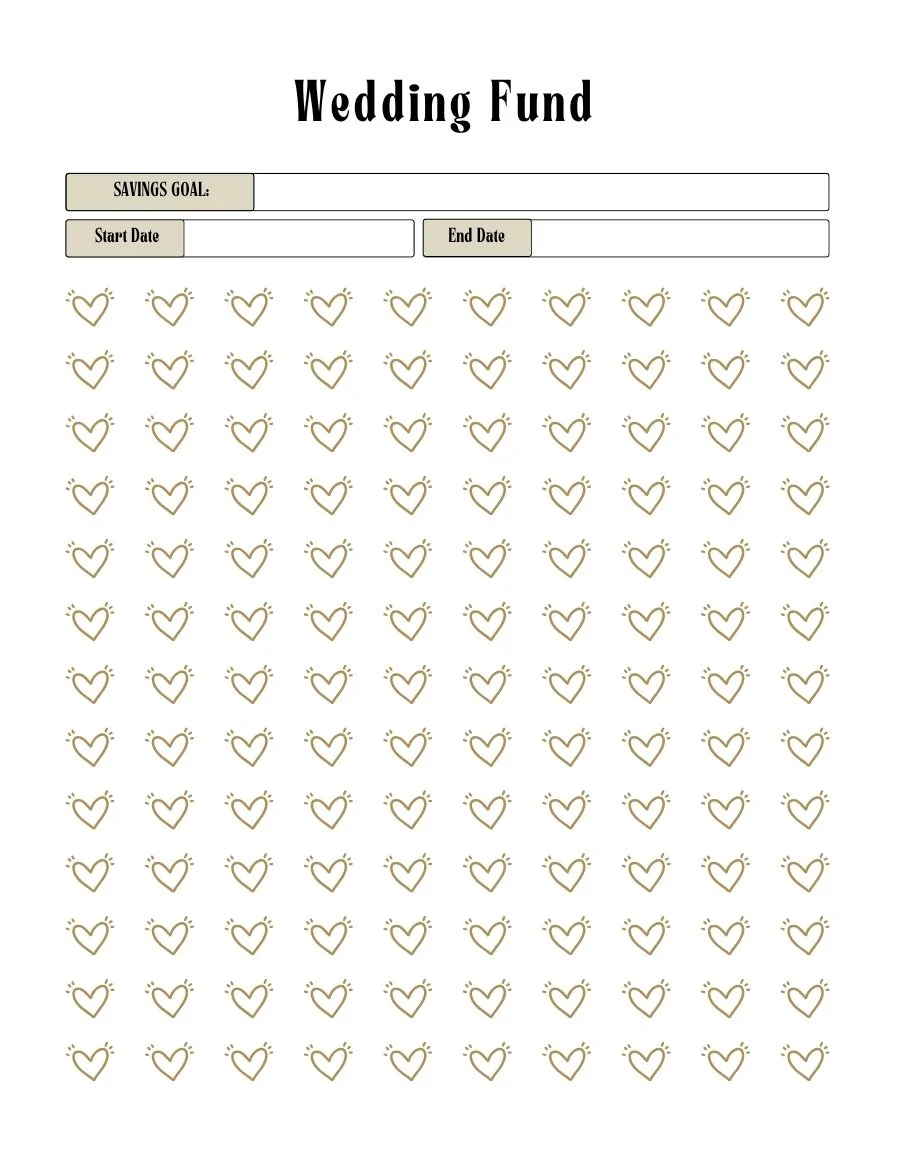
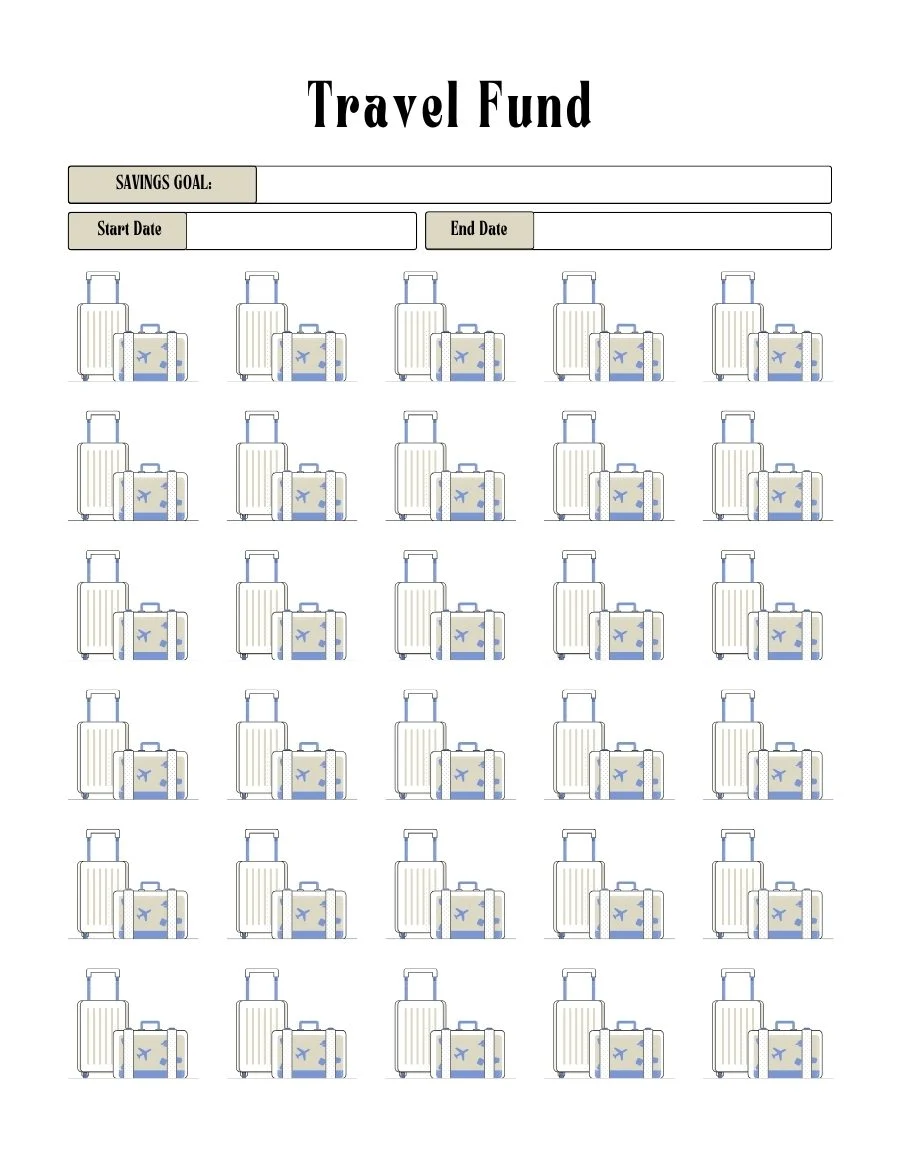
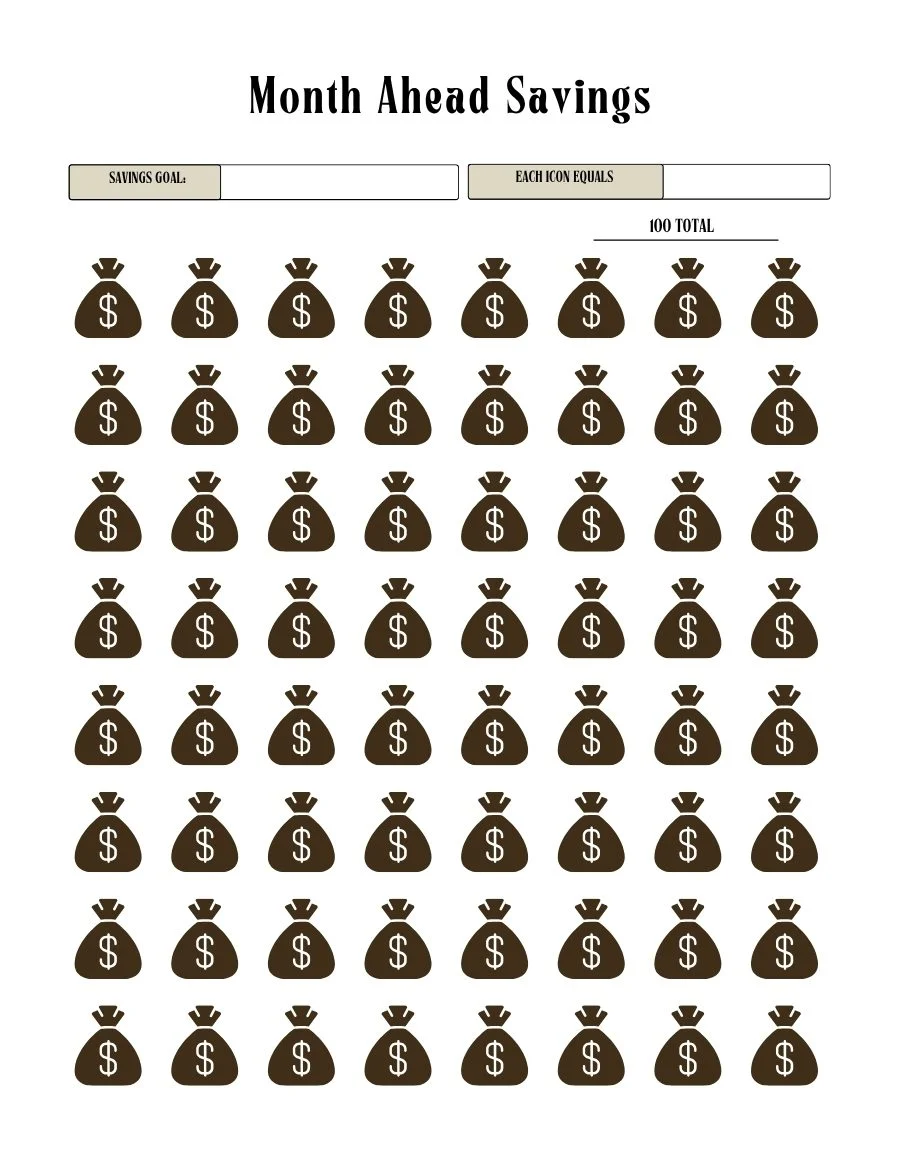
Saving for emergencies protects you. Saving for something you want keeps you motivated. Goal fund trackers give each dream its own page: a wedding, a trip, a new baby, a car, or simply a “dream fund”. You write the savings goal, the start date and the end date, then decide what each icon is worth. If your travel goal is $1,800 and the page has 30 suitcases, each one equals $60.
This is the same idea as the sinking funds we cover in our complete budget planner guide: divide a future cost by the number of months you have, and save that amount every month. The tracker simply makes it more fun to watch.
The month ahead savings challenge
One of the most powerful goals is not a thing at all: it is getting one month ahead. The idea is to save enough to pay next month’s bills with this month’s income. Jesse Mecham calls this “age your money” in You Need a Budget: once you live on last month’s income, a late paycheck or a surprise expense stops being a crisis. Set your savings goal to one month of essential expenses, decide what each money bag is worth, and color them in as you go.
The no-spend challenge: find money you did not know you had
Sometimes the fastest way to save is to stop spending for a while. A no-spend challenge is a set period, a weekend, a week or a whole month, during which you buy only essentials you define in advance: rent, bills, groceries, fuel and medication. Everything else waits. Canadian writer Cait Flanders took this to the extreme with a year-long shopping ban, which she describes in The Year of Less: the money she saved mattered, but the bigger change was noticing why she shopped in the first place.
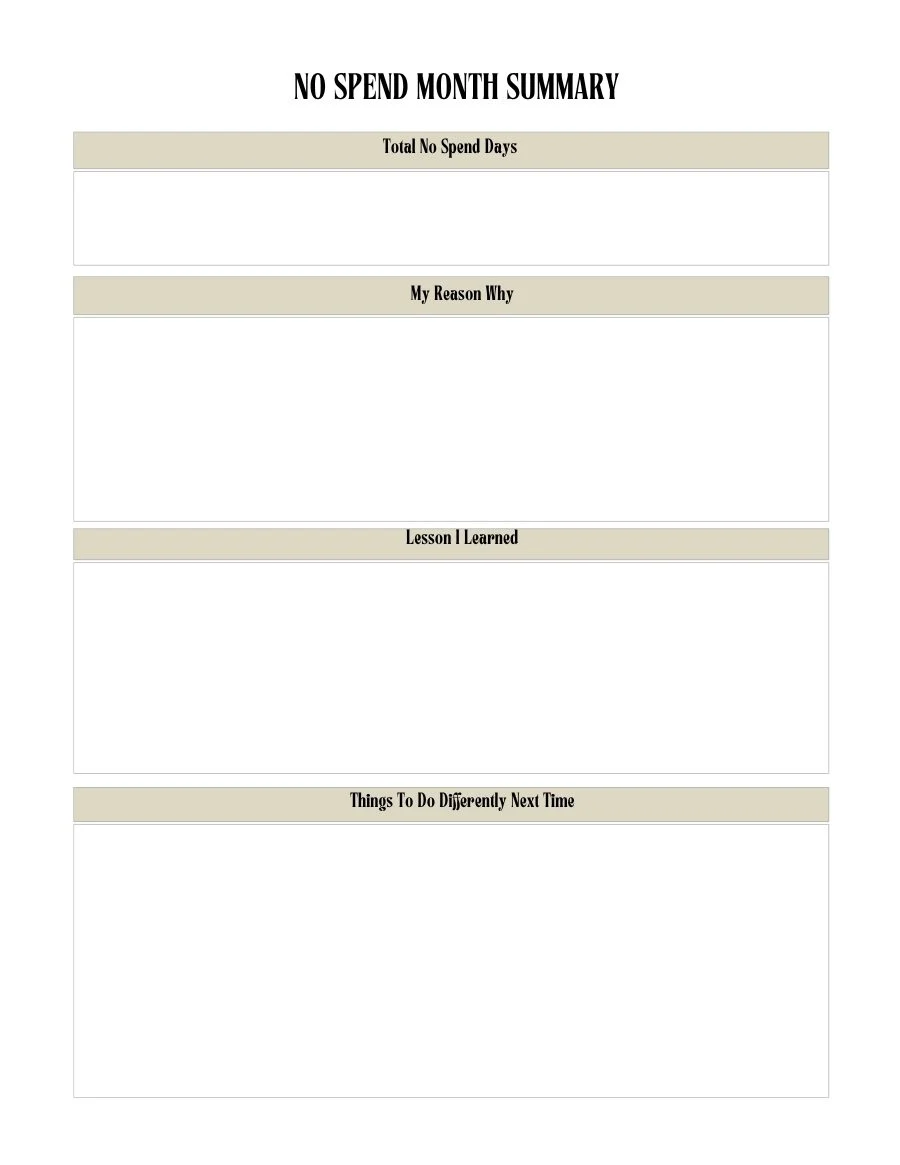
The most useful part of a no-spend month is the review at the end. Write down:
- Total no-spend days: count them, and celebrate the number.
- My reason why: the goal that kept you going.
- Lessons learned: which triggers made you want to spend (boredom, stress, social media, payday).
- Things to do differently next time: one or two changes for the next round.
Move the money you did not spend straight into your current savings challenge. A no-spend week followed by a big deposit is one of the most satisfying combinations there is. For rules and exceptions, see the no-spend step in our guide on building a budget that lasts.
How to choose the right money saving challenge
Use this table to match a challenge to your budget and your goal. When in doubt, pick the shorter, easier one: finishing a small challenge beats abandoning a big one.
| Challenge | Total saved | Duration | Average effort | Best for |
|---|---|---|---|---|
| $100 in 30 days | $100 | 1 month | About $3.30 a day | Complete beginners |
| 30 day challenge | $300 | 1 month | About $10 a day | Weekly or tip income |
| $300 in 25 days | $300 | 25 days | About $13 a day, 2 free days | A short, flexible sprint |
| 26 week challenge | $702 | 6 months | About $27 a week | A gift or trip fund |
| Emergency challenge | $1,000 | Your pace | $10 per box | Your first safety net |
| 52 week challenge | $1,378 | 1 year | About $26.50 a week | Building a long-term habit |
| 100 envelope challenge | $5,050 | 100 days to 1 year | About $50 a day over 100 days | Higher incomes, or a stretched timeline |
A simple rule of thumb: your challenge should not take more than a fraction of what is left after bills. If a week’s deposit means putting groceries on a credit card, the challenge is too big. Scale it down; you can always start a second one later.
How to stick with your challenge until the last box
Starting is the easy part. These habits make the difference between a half-colored page and a finished one.
Put your deposits on the calendar
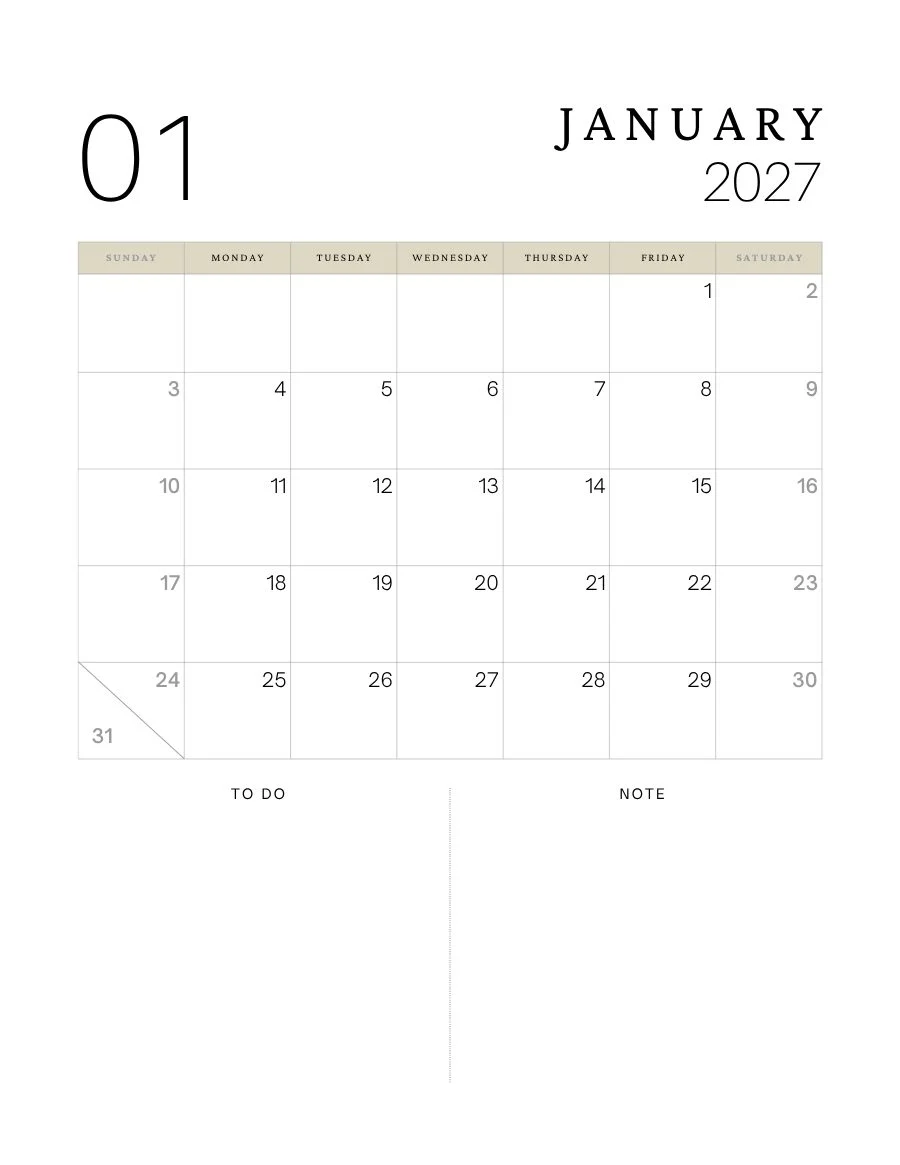
Write each deposit day on a monthly calendar, ideally the day after payday. A deposit with a date is an appointment; a deposit without one is a wish. Use the to-do list to note the transfers you need to make, and the notes box for anything that gets in the way.
Automate what you can
David Bach’s main lesson in The Automatic Millionaire is that automatic savings beat good intentions. If your challenge has a fixed weekly amount, set up an automatic transfer and simply color in the box when it happens. Keep the manual, pick-a-box challenges for small daily amounts.
Never miss twice
You will miss a deposit at some point. James Clear’s rule in Atomic Habits is simple: missing once is an accident, missing twice is the start of a new habit. If you skip a week, make the next deposit a priority, even if it is smaller than planned.
Make it enjoyable
Katy Milkman, the Wharton professor who co-authored the fresh start research, describes a technique called temptation bundling in her book How to Change: pair a task you tend to put off with something you enjoy. Do your weekly savings check-in with your favorite coffee, a podcast or a friend doing the same challenge. The more pleasant the moment, the more likely you are to come back.
Plan small rewards
Celebrate milestones at 25%, 50% and 75%, with rewards that cost little or nothing: a movie night at home, a long walk, a new library book. Rewards should support the goal, not undo it.
If staying consistent is hard for you in general, the routines in our ADHD planner guide (a visible home page, tiny priorities and a monthly reset) work just as well for savings as for daily tasks.
Common money saving challenge mistakes (and how to avoid them)
- Choosing a challenge that is too big. The 100 envelope challenge looks exciting on social media, but $50 a day is not realistic for most budgets. Start with a challenge you are almost sure you can finish.
- Keeping cash at home. It is easy to “borrow” from, and it loses value with inflation. Move the money to a separate savings account.
- Saving while paying 25% interest on a credit card. Build a small emergency cushion first, then put most of your extra money on high-interest debt. The savings challenge format works just as well for extra debt payments.
- Doing several challenges at once. Two half-finished challenges feel worse than one completed challenge. Finish one, then start the next.
- No goal written on the page. Without a named reason, the money slowly turns back into spending money.
- Quitting after a missed week. Adjust the plan, use a free day, or extend the finish date. The goal is progress, not perfection.
What to do with the money when you finish
Crossing the finish line is a big moment. Decide in advance where the money goes, so it does not quietly disappear into everyday spending:
- No emergency fund yet? Your first $1,000 goes there.
- High-interest debt? Put the savings toward the card with the highest rate, or the smallest balance if you need a quick win.
- Emergency fund in place? Fund your goals: the trip, the car, the holidays, or getting one month ahead.
- All of the above covered? Consider long-term savings or retirement accounts, and talk to a professional about investing.
Then start the next challenge while the habit is fresh. Many people use a short challenge as a warm-up, then move on to a 52-week challenge for the rest of the year. Morgan Housel puts it well in The Psychology of Money: saving is not only about a specific purchase; it buys room for error, the freedom to handle whatever the year brings.
Keep your savings and your calendar together.The Everything Planner 2027 combines year, month, week and day pages with a full Money section and monthly reviews: 801 hyperlinked pages for GoodNotes, Notability and Android tablets.
6 books that will help you save more
If you want to go deeper into the habits and the psychology behind saving, these books are a great place to start.
- Atomic Habits by James Clear: how tiny changes compound, why habit trackers work, and the “never miss twice” rule that keeps challenges alive.
- How to Change by Katy Milkman: the science of behavior change, including the fresh start effect and temptation bundling, explained by one of the researchers behind them.
- Nudge by Richard Thaler and Cass Sunstein: how defaults and small design choices shape our decisions, with the Save More Tomorrow program as a famous example.
- The Year of Less by Cait Flanders: a personal story of a year-long shopping ban and what it teaches about why we spend.
- The Automatic Millionaire by David Bach: why paying yourself first, automatically, beats relying on willpower.
- The Psychology of Money by Morgan Housel: why behavior matters more than knowledge with money, and why savings buy freedom.
Pick the one that matches your biggest obstacle: habits (Clear, Milkman), spending urges (Flanders), systems (Bach, Thaler) or mindset (Housel).
Frequently asked questions
What is the best money saving challenge for beginners?
Start with a short challenge you are almost certain to finish, such as saving $100 in 30 days or the emergency challenge with $10 boxes. A quick win builds the confidence and the habit you need for longer challenges like the 52-week challenge.
How much will I save with the 52 week savings challenge?
If you save $1 in week 1, $2 in week 2 and so on up to $52 in week 52, you will save $1,378 in a year. You can also run it in reverse, starting with $52, or choose your own fixed weekly amount on a blank tracker.
Is the 100 envelope challenge realistic?
The classic version saves $5,050 in 100 days, which is about $50 a day on average. That is too much for many budgets. Stretching it over a year, filling two envelopes a week, or using a smaller target makes it much more manageable.
Should I keep my challenge savings in cash?
It is usually better not to. Cash at home earns no interest and is easy to spend. Color in the box on your tracker, then transfer the amount to a separate savings account, ideally a high-yield one.
Should I do a savings challenge if I have credit card debt?
Build a small emergency cushion first so a surprise does not create new debt. After that, high-interest debt usually deserves most of your extra money. You can use the same challenge format to track extra debt payments instead of savings.
What if I miss a day or a week?
Do not start over and do not quit. Use a free day if your challenge has one, make up the amount over the next few deposits, or extend the finish date. What matters is getting back on track quickly.
A money saving challenge will not change your finances overnight, but it changes something just as important: it proves to you that you can save, one small box at a time. Pick your challenge, write your goal at the top of the page, and download the free savings challenge planner to color in your first box today.