Almost every wedding budget is built backwards. The couple falls in love with a venue, then a photographer, then a dress, and the total is whatever those decisions happen to add up to. By the time anyone writes a number down, half the money is already committed and the number is a report, not a plan.
A wedding budget that works runs the other way: one total first, decided from what you can actually pay, then a guest list, then everything else fitted inside. That order is unglamorous and it is the entire difference between a wedding you enjoy and one you are still paying for in two years. This guide walks through it step by step, with the real numbers behind each decision — and a free printable budget planner further down if you would rather work on paper.
This article is general education about planning your own money. It is not financial advice. For anything involving a loan or credit, talk to a qualified professional first.
What weddings actually cost right now
Start from real figures rather than from what you imagine, because the gap between the two is where budgets die. The Knot Worldwide’s 2026 Real Weddings Study, based on 10,474 US couples married in 2025, found an average wedding cost of $34,000 for an average of 117 guests — about $292 a head.
The averages that matter most are not the total, though. They are these:
| Guest count | Average total spent |
|---|---|
| 1–50 guests | $17,100 |
| 51–100 guests | $27,200 |
| Over 100 guests | $43,300 |
Read that table twice, because it contains the single most useful fact in wedding planning: the guest list is the budget. Not the venue, not the flowers. Everything else follows from how many people are in the room.
And the individual line items, from the same study, so you can sanity-check any quote you are given:
| Item | US average, 2025 weddings |
|---|---|
| Reception venue | $12,900 |
| Catering | $80 per person |
| Alcohol | $2,800 |
| Live band / DJ | $4,500 / $1,800 |
| Photographer / videographer | $3,000 / $2,300 |
| Flowers | $2,800 |
| Wedding planner | $2,100 |
| Dress | $2,100 |
| Rings | $3,000 |
| Event rentals / lighting and decor | $2,000 / $1,900 |
| Cake | $540 |
| Invitations and stationery | $510 |
| Transport | $1,100 |
| Officiant | $260 |
Three costs sit outside most people’s mental picture of “the wedding” and belong in the plan anyway: the engagement ring ($4,600), the rehearsal dinner ($2,800) and the honeymoon ($5,500).
Step 1: Decide the total from what you can pay, not from what it costs
Your budget is not a market rate. It is the sum of three amounts you can name today:
- What you have already saved and are willing to put into this.
- What you can save every month until the date, multiplied by the number of months. Be honest: this is the amount you can put aside without stopping rent, bills or the emergency fund.
- Contributions from family — but only amounts that have been said out loud, as a figure, by the person paying. “They’ll probably help with the catering” is not a number and must not be in the plan.
There is deliberately no fourth line. Credit is not a source of budget, it is a decision to pay more later for the same wedding — and it is far more common than people admit. LendingTree’s March 2025 survey of 1,050 newlyweds found that 67 percent took on debt for their wedding, and 34 percent felt pressured to spend beyond their means to impress guests.
Do this before anything else: both of you write your three numbers separately, then compare. Couples routinely discover a five-figure gap between what each assumed the other was contributing, and the cheapest possible time to find that out is now.
Step 2: Fix the guest list before you look at a single venue
At roughly $292 a head, every name is a decision worth about the price of a good dinner out — and it multiplies. One extra guest is one more meal, one more drink package, one more chair, one more invitation, more square metres of venue, more centrepiece.
Build the list in three tiers:
- A — could not happen without them. Usually smaller than you expect.
- B — you would be genuinely glad they were there.
- C — invited out of obligation or symmetry.
Price tier A alone, then A + B, then all three. The difference between the three totals is the clearest decision you will make all year, and it is much easier to make in a spreadsheet in January than in a florist’s showroom in June.
Two rules save more money than any negotiation: no plus-ones for guests you have never met, and one list, agreed by both of you, before either family is asked. A list that grows after the venue is booked forces you to either upgrade the venue or cut somewhere that hurts.
Step 3: Split the total across categories, then test it
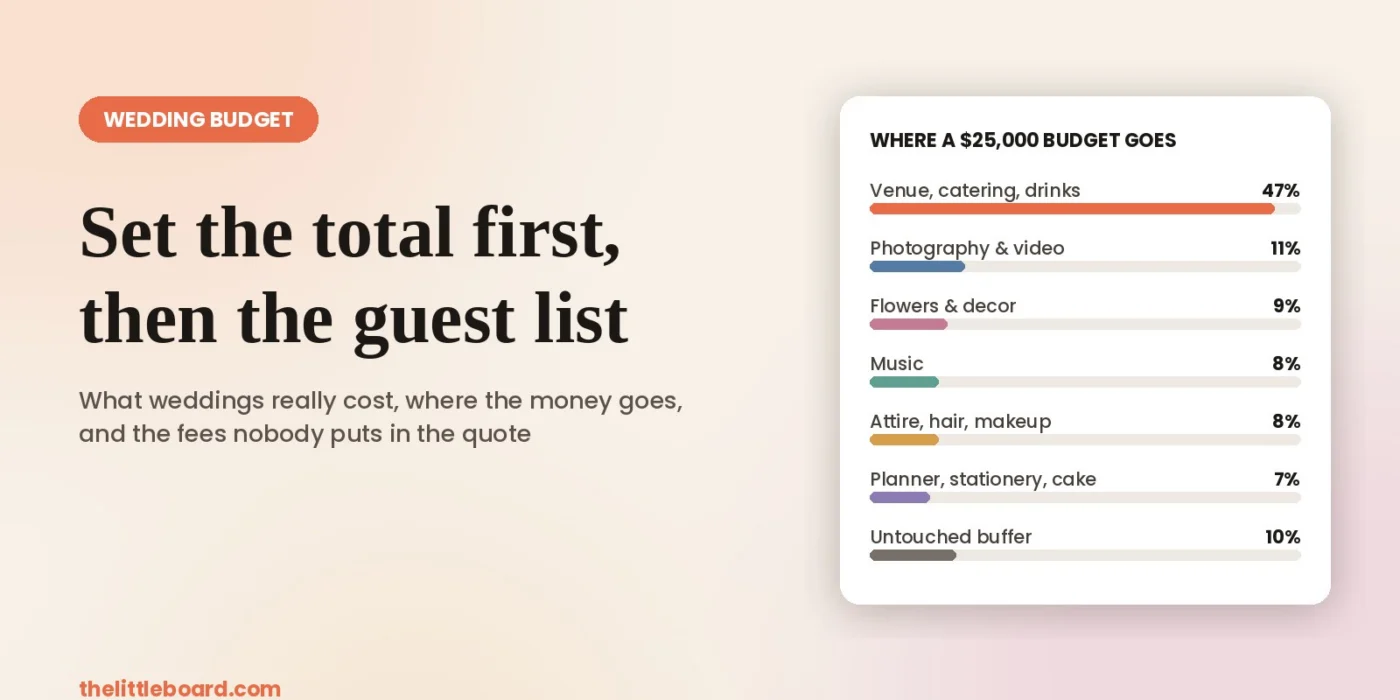
With a total and a guest count, you can lay out a first split. Planners have used roughly the same proportions for decades, and they are a sound starting point because they reflect where the money genuinely goes rather than where it feels like it should go.
| Category | Share of the total | On a $25,000 budget |
|---|---|---|
| Venue, catering and drinks | 45–50% | $11,250 – $12,500 |
| Photography and video | 10–12% | $2,500 – $3,000 |
| Flowers and decor | 8–10% | $2,000 – $2,500 |
| Music and entertainment | 7–10% | $1,750 – $2,500 |
| Attire, hair and makeup | 7–9% | $1,750 – $2,250 |
| Planner or coordinator | 5–8% | $1,250 – $2,000 |
| Stationery, favours, cake | 3–5% | $750 – $1,250 |
| Transport and accommodation | 2–4% | $500 – $1,000 |
| Untouched buffer | 10% | $2,500 |
These are a starting point, not a rule. If music is the thing you will remember, take four points from flowers and give them to the band. What matters is that every point you add somewhere comes out of somewhere else, on purpose, while the money is still on paper.
This is exactly the arithmetic our free wedding budget calculator does: you enter the total and the guest count, it splits the budget across the usual categories, shows the cost per guest, and tells you what you would have to save each month to reach your date.
A worked example. Say the total is $25,000 and the list is 120 guests. The calculator puts you at about $208 a head — below the national average, which is fine, but it immediately tells you that a $95-a-head catering quote will not work at that guest count. Two options, both visible in seconds: drop to 95 guests, which lifts you to $263 a head and makes that quote comfortable, or keep 120 and find catering nearer $70. Run it both ways before you visit anywhere. The point of the tool is not the split it produces, it is that it makes the trade-off a number instead of an argument at eleven at night.
Step 4: Replace averages with real quotes, one by one
Your first budget is built on averages, and averages are wrong for you specifically. As each real quote arrives, put the actual figure into the plan and look at what it does to the bottom line the same day — not at the end of the month.
When you collect quotes, insist on three things in writing every time:
- What is included, hour by hour. “Eight hours of coverage” and “until midnight” are different contracts.
- The all-in figure, with tax and service charge. A 22% service charge on a $12,000 catering bill is $2,640 that never appeared in the conversation.
- The payment schedule. Deposits, second instalments and final balances land on specific dates, and that calendar matters as much as the total.
That last point deserves its own line, because it is the one most couples miss: a wedding is not one payment, it is fifteen payments spread over a year. Write every due date in a calendar as soon as you sign, and you will never be surprised by a $4,000 balance falling in the same week as the rent.
- 73 printable pages, US Letter PDF
- Budget, bills, savings, debt & goals
- Instant download, no spam
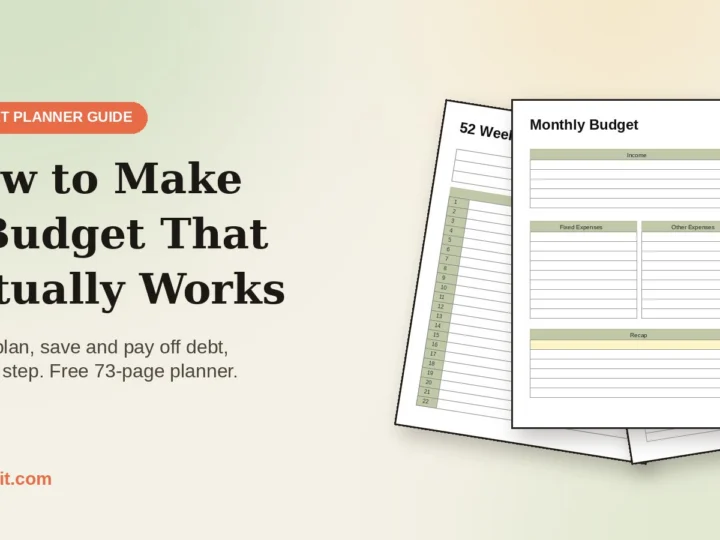
Get the free 73-page budget planner
Every page from this guide in one printable file: monthly budget, spending and bill trackers, sinking funds, savings challenges, debt payoff, net worth and a full 2027 calendar.
Step 5: Keep ten percent you never allocate
Set aside a tenth of the total and do not give it a job. Not “flowers, roughly” — nothing. It exists to absorb the difference between the wedding you planned and the wedding that happens.
The size of that gap is measurable. The Knot’s 2024 study of nearly 17,000 couples found that among those whose budgets were affected by rising costs, 53 percent spent more than planned, by an average of $7,347. On a $25,000 wedding, a 10% buffer is $2,500 — not enough to cover an overrun of that size, but enough to absorb the two or three ordinary surprises that cause most of it.
The rule that makes a buffer work: you may only spend it on something that already exists in the plan. It covers the catering bill that came in $600 high. It does not fund a sparkler exit that nobody had thought of in March.
Step 6: The costs nobody quotes you
Every over-budget wedding has the same shape — the big items came in roughly right and a long tail of small ones finished the job. Put these in your plan on day one, at a guess, rather than meeting them one at a time:
- Tips and service charges — often 18–22% on catering and bar, plus cash tips for the people who set up and clear away.
- Vendor meals. Photographers, videographers, the band and the planner eat. Most contracts require it.
- Alterations. Routinely several hundred dollars on a dress, and almost never quoted with it.
- Beauty trials for hair and makeup, at close to the full price of the day itself.
- Postage. Square or thick invitations cost more to send, times 117 guests, twice if you send save-the-dates.
- Overtime. The hourly rate after the contracted end time, for the venue, the band and the photographer.
- Cake cutting and corkage fees — per slice, per bottle, and very easy to miss in a contract.
- The marriage licence, and any officiant travel.
- Welcome bags, signage, printing and the small run to the shops the day before.
- Shipping and returns on everything ordered online, which for decor adds up fast.
Give this list a single line in your budget — three to five percent of the total is realistic — instead of pretending each item will come from somewhere.
Step 7: Turn the gap into one monthly number
Once the total is set, the plan becomes arithmetic:
(total − already saved − promised contributions) ÷ months until the wedding = what you save each month
On a $25,000 wedding with $6,000 saved and $5,000 promised by family, fourteen months out, that is $1,000 a month. Either that number is possible or it is not, and knowing which one in January is worth more than any discount you will negotiate later. If it is not possible, you have three honest levers and only three: fewer guests, a later date, or a smaller total.
Then make the saving automatic and keep it out of your current account. A wedding fund is the textbook case of a sinking fund — a known cost, a known date, divided by the months in between — and our guide to those covers how to run one alongside all the other irregular costs that do not stop just because you are getting married.
Step 8: Four cuts nobody at the wedding will notice
When the monthly number is too big, cut in this order. Each of these changes the total materially and changes the day almost not at all.
1. Twenty fewer guests. At the national average that is roughly $5,800, and it is the only cut that reduces catering, bar, rentals, stationery, favours and venue size all at once. It is also the only one that makes the day feel more intimate rather than more modest.
2. A Friday, a Sunday, or a month outside peak season. Venues and photographers price by demand, and the same wedding on a Friday in March frequently costs a fifth less than on a Saturday in September.
3. Change the bar format, not the bar. Beer, wine and one signature cocktail instead of a full open bar cuts the drinks line substantially, and most guests genuinely do not register the difference.
4. Fewer flower arrangements, moved twice. Ceremony arrangements carried to the reception, greenery instead of blooms out of season, and larger tables so you need fewer centrepieces.
What not to cut first: photography, and the person who runs the day. Those two are the ones couples most often say they regret trimming, because one is what you keep and the other is what stops you working at your own wedding.
If you are thinking about borrowing
Two-thirds of newlyweds do, so this is worth thinking through rather than sliding into. The problem is not that borrowing is reckless — it is that the cost is invisible at the moment you decide. A $10,000 balance carried at a typical credit card rate takes years and adds thousands, and it lands on a household that is simultaneously trying to save for the other things that arrive after a wedding.
If some of the money is already borrowed, get a clear picture before you plan the rest: our free debt snowball vs avalanche calculator shows what your balances actually cost and how long two different payoff orders would take. Seeing the real debt-free date next to the wedding date tends to settle the question of whether the sparkler exit is worth it.
The honeymoon is a separate budget
The Knot puts the average honeymoon at $5,500 — roughly a sixth of an average wedding, and almost always planned last, with whatever is left. Give it its own total and its own savings line from the start, or it becomes the thing that goes on a card in the week you were meant to be relaxing.
Price it properly rather than guessing: our free travel budget calculator turns flights, nights, food and activities into a total, a cost per traveller and a cost per day, and tells you what to put aside each month to land on it. Do it in the same week you set the wedding total, not the week after the wedding.
Fifteen payments over fourteen months.A hyperlinked planner with a year view, savings pages and a budget section in one file, so every deposit date sits on the same calendar as everything else.
Four books worth reading before you book anything
A Practical Wedding — Meg Keene. The best antidote to wedding-industry pressure in print: what actually matters on the day, what you are allowed to skip, and how to have those conversations with family. Read this one first.
How Big Things Get Done — Bent Flyvbjerg and Dan Gardner. Why projects overrun, and the fix: estimate from what similar things really cost rather than from your own best case. A wedding is a project, and this is why your first estimate is low.
The Psychology of Money — Morgan Housel. On room for error, and on the difference between what impresses other people and what you actually want. Directly relevant to the third of couples who feel pressured to overspend.
I Will Teach You to Be Rich — Ramit Sethi. The mechanics: a named savings account, an automatic transfer on payday, and deciding once instead of renegotiating with yourself every month.
Frequently asked questions
How much should a wedding cost?
There is no correct figure — only what you can pay without borrowing. For reference, US couples married in 2025 spent an average of $34,000 for 117 guests, but the useful number is the per-guest one, about $292. Multiply your guest count by a per-head figure you are comfortable with and you have a defensible starting total in one line of arithmetic.
What percentage of the wedding budget goes to the venue?
Venue, catering and drinks together take 45 to 50 percent of most budgets. If a venue quote takes you past half your total before you have booked anything else, either the guest list or the venue has to change — that ratio rarely recovers later.
How far ahead should we start saving?
As early as you can, because the months are the only variable entirely in your control. Divide what you need by the months you have; if the monthly figure is uncomfortable, adding six months to the engagement is usually easier than removing $6,000 from the wedding.
Who traditionally pays for what?
Traditions vary and matter far less than clarity. What matters is that every contribution is a specific amount, stated by the person paying, before you build the plan around it. A vague offer of help is generosity; it is not budget.
Is a wedding planner worth the money?
Often yes on a bigger wedding, because a good coordinator negotiates, catches the contract clauses that cost you money, and stops you running your own event. On a small, simple day, a day-of coordinator at a fraction of the price does most of the work that matters.
How do we stop the budget creeping up?
Two habits. Every addition has to come out of another line the same day, not out of “we’ll see”. And every quote goes into the plan as an all-in figure with tax, service charge and tip, so the total on your page is always the total you will actually pay.
Start with one number
Before you visit a venue or save a single picture, write down three figures — what you have, what you can save each month, and what has actually been promised — and add them up. Then take our wedding budget calculator, run that total against the guest list you want and against twenty fewer, and see the two numbers side by side. That is a twenty-minute conversation that will shape the next fourteen months, and it is far more useful than any amount of browsing. If you want the paper version to work from, grab the free printable budget planner and start with its savings pages.
Read next
- Sinking funds: how to pay for big one-off expenses without borrowing — the method behind every calculator on this site.
- How to make a budget that actually works — the full method, from an honest snapshot to a monthly money date.
- Money saving challenges that you will actually finish — structured ways to build the first $1,000.